Meal trays and carts for juvenile facilities
Plan the complete meal schedule, including snacks, classroom timing and supervised dining.
TL;DR
- Juvenile facility selection should begin with the approved menu, meal and snack schedule, dining setting and individual meal needs. Test the full place setting and wash cycle with food service, custody and the superintendent before agency purchasing places an order.
Who selects dinnerware for a juvenile facility?
Assign the superintendent, food service manager, nutrition reviewer, custody staff and agency purchasing contact to the equipment review. Food service should demonstrate portions and handling. Custody should review issue and return procedures. Purchasing should document the approval route and the accepted items. The federal juvenile handbook provides a food service reference; the facility's state or county agency must identify its own governing requirements.[1]
Include staff who serve meals in small groups or deliver meals to separate rooms. Their review should cover carrying the tray, receiving a drink, using utensils and returning the complete setting. Where the facility participates in a school meal program, have its program administrator identify the menu, portion and record requirements used for that site.
How do meals and snacks affect dinnerware quantities?
Map each meal and snack against class periods, recreation, appointments and the approved dining schedule. Count the people served at each location. Identify supervised dining, meals delivered to rooms and any temporary separation arrangements. Calculate the room-service share from the facility schedule and counts.
Track each reusable item between services. A bowl used for breakfast may still be drying when another group needs it. A tray used for a separate meal may return later than the dining-room trays. Calculate clean stock from these overlapping cycles and record the planned reserve separately. Include return and washing in the schedule for each group.
Which plates, bowls and trays should staff evaluate?
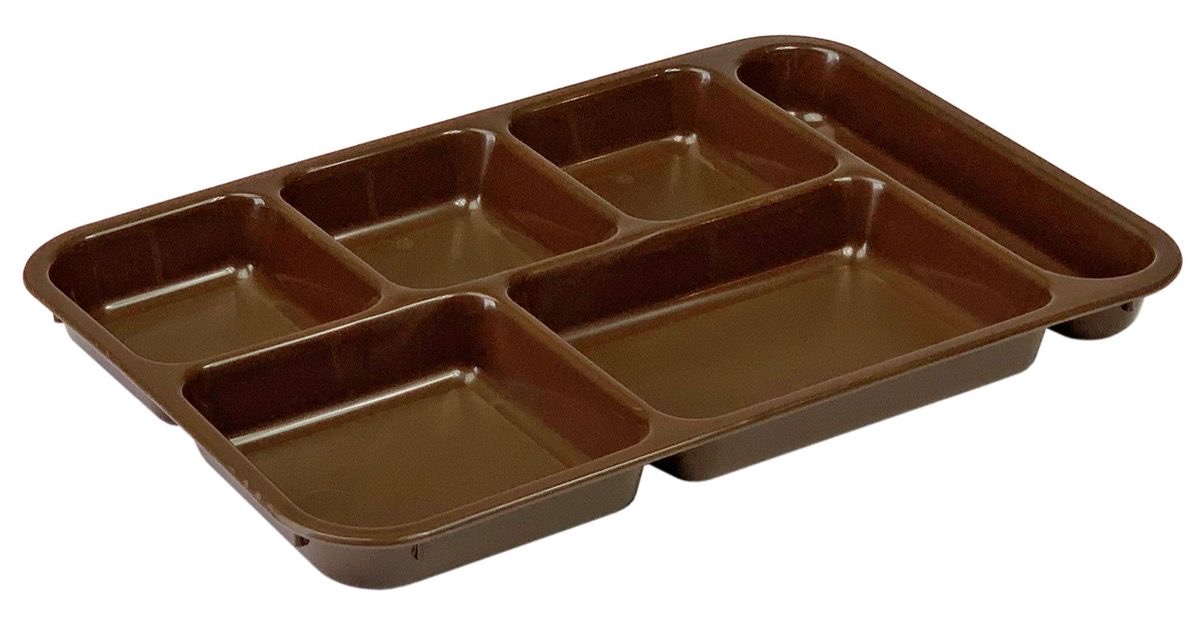
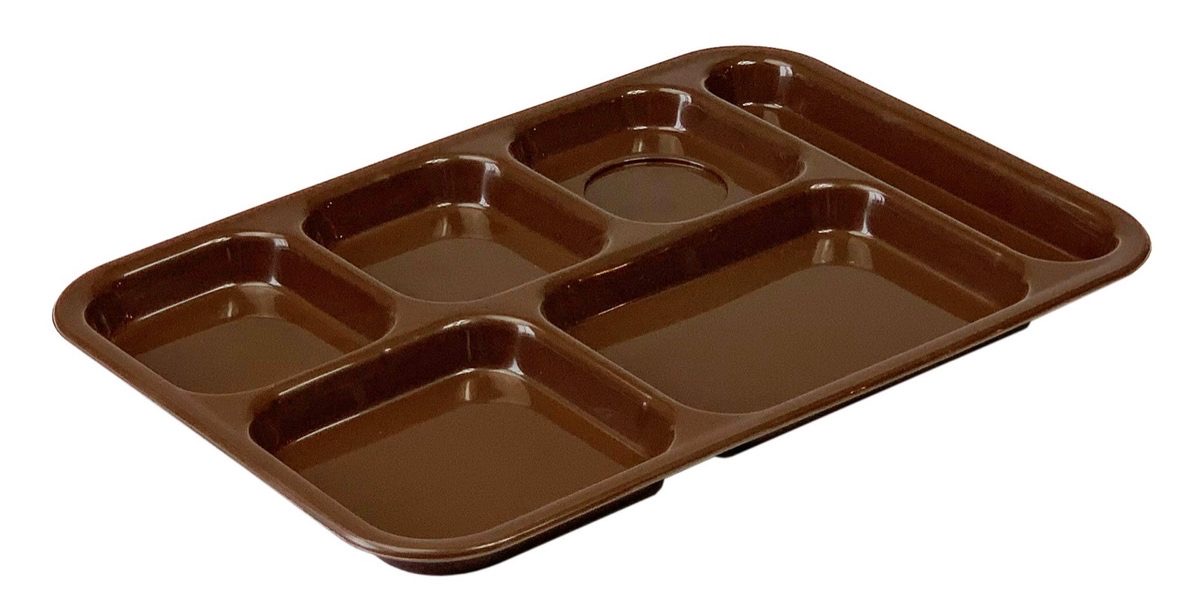
Choose the layout from the approved menu and the way food is served. Dietary trays provide a surface for a place setting, while compartment trays provide defined food spaces. Evaluate carrying stability and portion clearance with the complete meal.
| Product | Printed specification and evaluation question | Specification source |
|---|---|---|
| NDP-9 dinner plate | 9-inch diameter and 0.75-inch height. The sheet identifies copolymer and dishwasher suitability. Test the intended meal and carrying method. | 9-Inch Dinner Plate.pdf |
| SRSB-15 rimmed bowl | Printed capacity is 16 ounces; diameter is 6.50 inches and height is 2.25 inches. Match the portion to the usable serving space. | 16oz Rimmed Bowl.pdf |
| SCP-11 three-compartment plate | Copolymer plate, 10.88-inch diameter and 0.94-inch height. Large compartment 9 ounces, small compartments 5 ounces. 24 plates per case. | 3-Cmpt Plate.pdf |
| SDP-6 dessert plate | Copolymer plate, 6.38-inch diameter and 0.56-inch height, with a raised perimeter. 72 plates per case. | 6-Inch Dessert Plate.pdf |
| SVD-5 vegetable dish | Copolymer dish, 5.00-inch diameter and 1.25-inch height, with a printed capacity of 5 ounces. 72 per case. | 5oz Dish.pdf |
| PPST-18 dietary tray | 18 × 14 × 0.8 inches. The sheet identifies copolymer. Check the loaded plate, bowl and drink arrangement with staff. | 18x14 Dietary Tray.pdf |
| PPST-28 6-compartment deep tray | Copolymer tray, 14.25 × 9.88 × 1.5 inches; 2.56 inches high with the PPSTL-28 lid. Entrée compartment 18 ounces. 24 trays per case. | PPST-28.pdf |
| PPST-14 6-compartment tray | Copolymer tray, 14.25 × 9.88 × 0.88 inches, with no compatible lid. Entrée compartment 9 ounces, with a beverage slot in one compartment. 24 trays per case. | PPST-14.pdf |
If a flexible tray is part of the facility's review, MaxFlex tray specifications identify individual models. The FXSTB-28 sheet lists a 14.25 × 9.88 × 1.5-inch tray with a 2.50-inch height when lidded.[6] Have the responsible staff assess the loaded sample and authorize its use. Product selection must follow the facility's individual handling and security requirements.
For transported meals, start the meal-delivery equipment review with the number of complete settings and the longest route. Record power, doorway clearance and receiving surfaces. Choose the cart configuration from those measurements and the menu's temperature-control process.
What does a juvenile meal and snack trial include?
Planning example, assumed counts. A facility has 36 meal recipients. Assume 30 use supervised group dining and 6 receive separate delivery. The separate-delivery share is 6 ÷ 36, about 16.7%. Replace these assumed counts with facility records before sizing equipment.
- Approve the day's menu and service times. List the exact plate, bowl, drinkware, tray and utensil needed for each group and each separate meal.
- Test the complete place setting with representative portions. Check staff handling, tray balance and whether food contacts another item when the setting is carried.
- Serve the group meal and separate route under the facility supervision plan. If the tested separate-delivery load is 3 complete meals, the 6-meal route needs 2 loaded outbound trips. Replace that assumed load with the actual trial result.
- Record meal handoff, food checks and the count of each item issued. Reconcile returned pieces and follow the approved response for a missing utensil or damaged dish.
- Run the approved wash and sanitizing cycle, allow items to air-dry and verify clean stock before snack service. If all 36 meal bowls remain unavailable when 36 snack bowls are needed, the schedule needs 72 usable bowls before the chosen reserve.
How should special diets and separate meals be handled?
Use the approved diet list to identify ingredients, portions and the responsible reviewer. Keep identification linked to the person and destination through the handoff, using the facility's privacy practices. Staff can use tray color as a local handling aid. Keep the diet instruction in the meal record and verify it at handoff.
Evaluate covers, carrying space and receiving surfaces for meals delivered outside the group dining area. Include a replacement-meal procedure for someone returning after the scheduled service. Specify who authorizes the meal, where it is held, how it is checked and how its dinnerware returns to the wash area.
Which juvenile food service standards should be reviewed?
The OFDT Juvenile Performance-Based Detention Standards handbook from February 2011 describes three meals plus a snack daily, with at least two hot meals, in section D.[1] This is a dated federal reference. The agency should confirm whether it applies and identify the current state juvenile rules, food authority requirements, contract provisions and any school meal program obligations for the facility.
Carry the facility's approved schedule and food checks into the trial. CDC correctional food safety guidance addresses spare dinnerware, damaged items, temperature records and remote feeding.[2] Use those operating topics to test the complete process alongside the applicable agency instructions. Keep the equipment acceptance record and staff responsibilities with the purchasing file.
What should accompany a juvenile facility sample request?
Send the menu, existing model numbers, dining arrangement, separate-meal count, wash process and proposed sample list. Include utensils and drinkware in the setting review even when only a tray is being replaced. Record how staff will assess carrying, cleaning, drying and storage.
Request Free Samples for the documented trial and Request a Quote for the accepted quantities. For transported meals, Schedule a Virtual Demo with the route measurements and menu ready. Ask the agency purchasing contact to confirm who approves the final equipment and where the order should be delivered.
Standards and purchasing guides
The ACA guide below addresses adult facility standards. Ask the juvenile agency to identify the accreditation requirements used for this facility.
Frequently asked questions
Does a juvenile facility need the same tray as an adult jail?
Approval depends on that facility review and its governing requirements.
How do snacks change the quantity of bowls needed?
Count bowls still in service, waiting to be washed or drying when the snack starts. Add the clean bowls needed for that service and the reserve chosen by the facility. Keep those assumptions visible in the order calculation.
Does a bowl model number show its capacity?
The SRSB-15 sheet prints a capacity of 16 ounces. Staff should also test portion size and carrying clearance with the actual food.
Who should approve a flexible tray sample?
Include food service, the responsible custody or security reviewer and the facility administrator. Record the model, intended use, loaded-meal trial and care review before purchasing.
Plan the equipment review with JonesZylon
Send your menu, route measurements, current model codes and purchasing requirements.
800-848-8160 | solutions@joneszylon.com | 305 Center Street, West Lafayette, OH 43845
Sources
- OFDT Juvenile Performance-Based Detention Standards, February 2011, section D. https://www.justice.gov/archive/ofdt/juvenile.pdf (accessed 2026-09-05)
- CDC model food safety practices for correctional facilities, 2024 guidance. https://www.cdc.gov/correctional-health/media/pdfs/2025/02/Model-Food-Safety-Practices-for-Correctional-Facilities_508.pdf (accessed 2026-09-05)
- 9-Inch Dinner Plate specification sheet. /pdf/Dinnerware/Plates%20and%20Bowls/9-Inch%20Dinner%20Plate.pdf (accessed 2026-09-08)
- 16oz Rimmed Bowl specification sheet. /pdf/Dinnerware/Plates%20and%20Bowls/16oz%20Rimmed%20Bowl.pdf (accessed 2026-09-08)
- 18x14 Dietary Tray specification sheet. /pdf/Dinnerware/Dietary%20Trays/18x14%20Dietary%20Tray.pdf (accessed 2026-09-08)
- FXSTB-28 specification sheet. /pdf/Dinnerware/Compartment%20Trays/FXSTB-28.pdf (accessed 2026-09-08)
- 3-Cmpt Plate (SCP-11) specification sheet. /pdf/Dinnerware/Plates%20and%20Bowls/3-Cmpt%20Plate.pdf (accessed 2026-10-26)
- 6-Inch Dessert Plate (SDP-6) specification sheet. /pdf/Dinnerware/Plates%20and%20Bowls/6-Inch%20Dessert%20Plate.pdf (accessed 2026-10-26)
- 5oz Dish (SVD-5) specification sheet. /pdf/Dinnerware/Plates%20and%20Bowls/5oz%20Dish.pdf (accessed 2026-10-26)
- PPST-28 specification sheet. /pdf/Dinnerware/Compartment%20Trays/PPST-28.pdf (accessed 2026-10-26)
- PPST-14 specification sheet. /pdf/Dinnerware/Compartment%20Trays/PPST-14.pdf (accessed 2026-10-26)