Buying correctional foodservice equipment
TL;DR
- Start with the menu, housing-unit count and delivery route. Specify the tray, lid and cart configuration together, then check washing, drying and storage.
- Give purchasing a written equipment list, a sample evaluation record and a schedule tied to the facility budget cycle.
Which facility and meal service are you buying for?
Write down who receives meals, where staff assemble each tray and who controls delivery. A county jail with changing population, a state prison with several housing units, a federal institution, an immigration detention facility and a juvenile facility can need different equipment configurations. A private operator or food service contractor should identify which assets belong to the agency and which belong to the contractor before requesting replacement equipment.
Record occupied population by service period, special-diet meals, staff meals and late arrivals. Identify the people who approve the menu, security handling, sanitation, maintenance and purchase. The ServeSmart buying guide organizes selection around the tray, cart type, cart size and delivery system. Use those questions to prepare a facility-specific request. [1]
Will meals go through a chow hall or to housing units?
For chow-hall service, follow the movement from clean dinnerware storage through the serving line to the return station. Check where plates, bowls, cups and utensils are issued and counted. For in-cell feeding, trace the loaded tray through every controlled door and handoff. Measure the actual food-service opening if the tray must pass through it, including the lid and the staff member's working clearance.
For satellite service, record where bulk pans leave the kitchen and where staff portion food. Identify the serving surface, utensils, handoff point and return route at each destination. For meals assembled in the central kitchen, record how staff match hot food, cold food, beverages and special diets before dispatch. The guide asks whether hot and cold items share a tray and whether trays ride on slides, shelves or stacks. [1]
Which tray family fits the menu and handling policy?
Bring the approved menu and portion utensils to a sample review. Fill the largest entrée, bread, side and beverage combinations served. Check food clearance under the lid or next tray and how staff remove a meal from a loaded stack. Compare SmartTrays, compartment trays, insulated trays and segregation trays by the relevant model sheet.
The PRTS-5000 sheet explicitly identifies the PRTSL-5000 lid. Keep the exact pair in the request, including replacement lids. [2] Security staff should review handling, issue and return procedures for the selected material. Request evidence for each proposed security feature and record the facility's acceptance decision. Use the exact SKU when asking about MaxFlex trays; have staff approve each model separately.
How many trays and carts will each route need?
Count meals that leave together by destination. Divide that dispatch count by the confirmed complete-meal capacity of the proposed configuration and round up to whole cart loads. If hot and cold portions travel in separate trays, count both pieces in inventory and document how they reunite at service. Keep delivered meals, physical tray pieces, cart loads and route trips in separate worksheet columns.
Build the tray inventory from pieces being filled, pieces in transit or service, pieces awaiting washing, pieces drying and the facility's chosen spare allowance. Use observations from the busiest service period to set those quantities. Keep trays awaiting drying out of the count available for the next trayline. Record actual turnaround time before converting a daily meal total into a purchase quantity.
Which cart configuration works on the route?
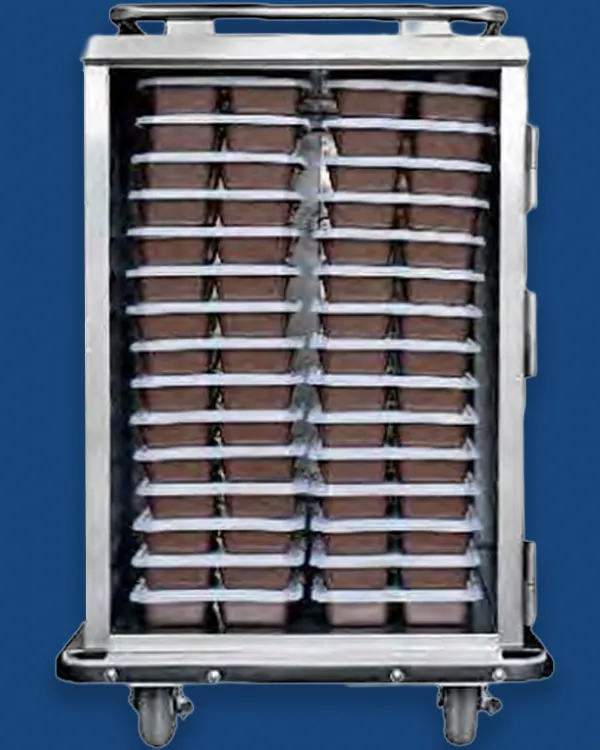
List heated, ambient and refrigerated needs for each menu component. For example, the JZHA-120 sheet identifies a heated/ambient cart, with a heating system on the left side. It provides no active refrigeration specification. [3] Request the model and configuration that match the proposed hot and cold workflow.
Measure door openings, elevator interiors, turns, thresholds and parking positions. Have facilities staff record available receptacles and circuits at staging points. Confirm tray count using the cart and tray compatibility guide; use the confirmed loading count to size the fleet.
Can the wash, dry and storage areas support the change?
Follow a sample through the facility's approved sanitation cycle. Record scraping, loading, washing, sanitizing, drying and clean storage. Check the tray and lid against the dish machine and chemical instructions, and check the cart against its own cleaning instructions. Get written care guidance for the selected equipment before deciding how staff will clean powered components.
Inspect the existing drying racks with the proposed sample. Record whether lids need separate slots, where clean pieces wait and how dirty returns stay separate. Ask maintenance to identify compatible spare parts and secure storage using the cart maintenance planning guide.
What belongs in the budget request?
Include any facility electrical or space work identified during the route review. Assign replacement inventory and service costs to the appropriate operating budget, and identify any capital approval needed for carts or infrastructure.
Work backward from the required service date through receiving, inspection, staff orientation, purchasing approval and the agency's budget cycle. Ask the bidder for a dated delivery proposal and quote validity. Keep warranty terms attached to the exact quoted model, including coverage, exclusions, claim contact and labor arrangements. Support replacement rates with facility records and delivery dates with the bidder’s proposal.
If the request cannot be funded outright in one budget year, decide early whether it will be financed, because that changes what the approval needs to show. Municipal financing covers the Equipment Finance Agreement JonesZylon offers through Ascentium Capital, what the included non-appropriations clause does, and which quoted charges to ask the finance provider about before a payment schedule reaches the board.
What should purchasing check for a cooperative order?
Ask the purchasing officer to identify an authorized route and review the actual contract documents. A cooperative or reseller discussion should identify the ordering entity, supplier, covered items, ordering period, pricing basis and any required local approvals. MRSC's piggybacking reference provides questions for a purchasing review. [4]
If a reseller proposes a contract vehicle, request its underlying documents and the offered SKU schedule. The Anchortex contracts page is a document lookup starting point. [5] This guide makes no claim that JonesZylon, a reseller, a product or a buyer qualifies for a particular contract. Use the corrections equipment RFP template to collect the same technical response whichever purchasing route the agency approves.
Frequently asked questions
What information should accompany a quote request?
Include meal counts by dispatch, exact tray and lid models, hot and cold workflow, route measurements, available power, sanitation process and required delivery date.
How should we determine spare tray quantities?
Measure how many pieces are filling, in service, awaiting washing and drying at the busiest overlap. Add the spare allowance selected by the facility and record the basis.
Does this guide establish cooperative purchasing eligibility?
No. The purchasing officer must review the supplier, contract scope, buyer authority and specific items before approving an order.
Talk to a JonesZylon corrections specialist.
800-848-8160 | solutions@joneszylon.com | 305 Center Street, West Lafayette, OH 43845
Sources
- ServeSmart Buying Guide.pdf (manufacturer document). /pdf/servesmart/ServeSmart%20Buying%20Guide.pdf (accessed 2026-09-08)
- PRTS-5000.pdf (manufacturer document). /pdf/Dinnerware/Insulated%20Trays/PRTS-5000.pdf (accessed 2026-09-08)
- JZHA-120.pdf (manufacturer document). /pdf/Equipment/Dual%20Temperature%20Carts/JZHA-120.pdf (accessed 2026-09-08)
- MRSC, Piggybacking, purchasing review reference (reference recorded in September 2026 research; confirm applicable edition). https://mrsc.org/explore-topics/procurement/basics/piggybacking (accessed 2026-09-05)
- Anchortex contracts, reseller document lookup (reference recorded in September 2026 research; confirm applicable edition). https://www.anchortex.com/pages/contracts (accessed 2026-09-05)
- GSA eLibrary, contractor record for THE JONESZYLON COMPANY LLC, contract GS-07F-049GA. https://www.gsaelibrary.gsa.gov/ElibMain/contractorInfo.do?contractNumber=GS-07F-049GA&contractorName=THE+JONESZYLON+COMPANY+LLC&executeQuery=YES (accessed 2026-09-11)